Friday, 7 August 2009

Day 26 - Scotland East Coast - Stonehaven - Dunnotar Castle rescued by Braveheart! And other dramatic things like the invention of pneumatic tyre.

Travel is all about random experiences, spontaneous and serendipitous. It's probably why people travel - to get away from the expected and controlled, and stumble across things that we never thought we would. Maybe it's got something to do with our ancient past as nomadic hunters and gatherers...

So Stonehaven, for me, was one of these. It's a seemingly straightforward, pretty coastal town on the east coast of Scotland. A small beach, sleepy main street, laid-back locals, some innocuously pleasant scenery. You drive into it, and say to yourself: "Nice", rather than "Cool!". But it's got a couple of more-than-nice surprises.

First up, Dunnotar Castle, about two miles to the south of the town's centre. Perched on a cliffed-promontory about 50 metres into the North Sea, the ruins are joined to the mainland by a low-flung stone causeway. There hasn't always been a castle on top, but it's been an important site of defence since 681 AD. And since then, it's had a history worthy of an action-packed film.


Dunnotar Castle, scene of Braveheart's "incineration" of the English in 1297, and now a somewhat more pleasant scene...click on the image for a full screen version.
Given its formidable natural setting, it would be very difficult to attack the castle. Well, except for William Wallace, the highland warrior leader who was celebrated in the film Braveheart by Mel Gibson. In 1297, he captured the castle from the English, whom we know - from the film - he hated intensely. And he did indeed, because once Willy's men had rounded up the English in the castle's church, he incinerated them by burning down the wooden enclosure in which he had imprisoned them. (By the way, Mel Gibson ended up shooting some of the scenes of the movie Hamlet at Dunnotar in 1990.)

In 1651, Oliver Cromwell's republican forces laid seige to the castle, to try and steal the Scottish Crown Jewels, but a priest's wife smuggled them out, and for some time they were hid in a small church to the south of Stonehaven.

It's open all year round, and - surprise! - it doesn't cost anything to visit. It's the first time on my trip that I've been able to visit a site of such historical importance, and not have to pay. And for me, at least, it's the most dramatic I've seen. So you must visit it.

We go now from the sublimbe to the mildly boring (at least in terms of any more potential Mel Gibson action flicks!). Stonehaven was the birthplace of Robert William Thomson, the inventor of the pneumatic tyre (and fountain pen!). So if it wasn't for Stonehaven, we'd all still be using horses to get around, and carving words into stone. Even a dramatic castle can't compete with RW Thomson.

Then, make a note of Carron Restaurant. It's an art-deco restaurant, situated on the town's little river, and is owned and run by the Cleavers. Robert is the chef and wife Jackie is the manager. They served me plenty of smoked salmon, even though it wasn't on the menu, and the mains of seatrout was fresh. They were friendly too, and just pleased to serve me a good meal. If you've got kids, and the restaurant is a bit quiet, Robert will take your kids into the kitchen, and let them put their own toppings onto their pizzas!

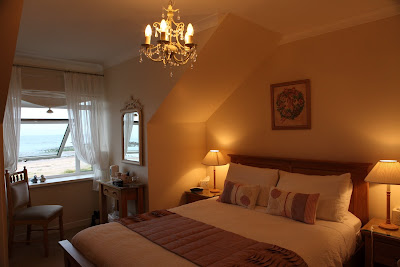
In fact, everyone I bumped into in Stonehaven was friendly. Especially Liz Molloy at The Beach View B&B, where I stayed. When I arrived earlier than expected, she was playing at Edzell Golf Course (which, interestingly, has a "bunker" on the 1st hole which was created by a German bomb, dropped during Second World War - and now called "Hitler's Bunker"!) She rushed back to set me up in the main room that looks over Stonehaven's beach. I slept with the window open all night, and the seawater flowed into my ears all night - audibly that is.


The sea-view room at The Beach View...

The Beach View only has two rooms, so you feel like it's your own holiday home. Liz is laid-back but attentive, and there are nice touches like binoculars in the rooms to see the birdlife - and occasionaly dolphins! - on the beach right in front of her property.

And then there's Jenna at the tourism information centre on Allardice street. She's generally fantastic. After talking to her, you'll feel like she's reason enough to visit Stonehaven.

A few other things that will keep you in Stonehaven for more than two nights:

- The Stonehaven Golf course runs along the coast, and is accordingly very scenic
- Visiting Cowie Shore to the north of town...only because it was there that the world's-oldest fossil of any air-breathing creature was found! (For the record, it's called Pneumodesmus Newmani.)
- Just south of town is a War Memorial, which is partly unfinished and ruined - intentionally so - to represent the unfinished and ruined lives of those men of Stonehaven killed during the world wars.

Cameron Clan Gathering in Achnacarry - some more videos

As promised, here are some more music vidoes from the Cameron Clan Gathering in Achnacarry, which I attended last week while staying near Spean Bridge at Corriegour Lodge Hotel. It was a real privilege to attend the gathering - not least because of the Gaelic music.

The Gaelic spoken in the Scottish highlands is grouped with the Irish and Manx Gaelic, and these are descended from Old Irish. They are also different to Welsh and Cornish. Some folk call it Scottish, which is different from the Scots Language, called Lallan, which is spoken in the lowlands, and is derived from Old English. Unfortunately, only about 1% of Scotland's residents speak it, and unlike Welsh, which is taught in schools, Scottish Gaelic isn't. So any celebration of it's use (whether music or just spoken) is something special.


Thursday, 6 August 2009

Day 25 - Scotland East Coast - From Thurso to Inverness - Dunrobin Castle - Hundreds of dead African animals, and some fantastic live ones

The weather continues to hold. And I got sunburnt today (the weather gods' revenge on my previous complaints), while watching a falconry display at Dunrobin Castle, between Thurso and Inverness. The 13th century castle has been amended and extended, so that today it is more of a very large, grand and ornate manor house.But the spirit of the castle still persists, given it's imposing height and architecture, position on a steep hill, and fantastic gardens. It was one of the highlights of my trip. Do yourself a favour, and go see it.

But the undoubted highlight is the display of falconer Andy Hughes and his birds of prey on the lower lawns of the castle. He gives a superb exhibition with his hawk, falcon and barn owl. Displayed in succession, each bird's characteristics and behaviour comes to the fore. Andy moves between the audience, and the birds fly low over their heads, and sometimes - in the owl's case - land on someone's head.

But the birds are wild. They simply allow Andy to feed them on an ask-and-reward system. So each time they fly back to Andy's hand, he gives them a piece of raw chicken. However, if he stopped feeding them, they'd happily fly off and find their own food.

You get to see the birds right up close, and Andy's knowledge is extensive, and he puts on a great show as well. You will be thoroughly entertained and educated. A must-do. Please don't miss it, so find out more at the Dunrobin Castle website. Also in his ranks, but not displayed to our audience today, are other birds such as the golden eagle, which can be viewed in the garden as well on their open-air perches.

Also at Dunrobin Castle is the museum of the Earl of Sutherland's hunting exploits in the 19th century in Africa. Be prepared for some disturbing viewing. There are hundreds of stuffed heads of once proud and beautiful African animals...from giraffe, to elephants, to buffalo, to the smallest animal and the largest. It's not for everyone, but it is a shocking reminder of how precious the remaining populations of wild animals are.

I then moved on to Inverness, and couldn't find any accommodation (it was the first night I hadn't planned in advance). During peak holiday season, make sure you don't make the same mistake. I eventually looked up on LastMinute.com, and found a spot overlooking Loch Ness, about 20 minutes inland from Inverness. Craigdarroch has great views of the loch - rooms are very spacious and comfortable. The food needs some attentions (my Thai Curry was rice and sauce - for £13!), but it may have been a one-off mishap. But it's a very relaxed atmosphere for such a grand building and location, and the South African owners keep a convivial bar where guests can carouse until the late hours.


Dunrobin Castle on the way from Thurso to Inverness. Click for a full screen version.


Dunrobin's museum of dead African animals, shot by the Earl of Sutherland during the 19th Century. If you're an animal lover, this might be too much for you.


Andy Hughes gives a superb "falconry" display at Dunrobin, which shouldn't be missed. He demonstrates various birds' (including the above barn owl) behaviourial characteristics, in a highly entertaining and educating display. Don't miss it!

Day 24 - Scotland North Coast - Thurso & Mey - People at the end of the island

Have you ever been somewhere remote? (I hope so!). Now think of someone who lives there. What do you think of them?

My experience is that some of the nicest people live the furthest from cities and towns. Funny how we spend our whole lives working busily to earn the right to slow down and live a simple life. Some folk get straight to the good stuff, and forego the ratrace.

Chris and Karen van Rooyen run a small B&B called Creag-na-Mara, within stone's throw (okay, probably a superhero's javelin throw) of Dunnet Head. According to the map, they live in the village of East Mey, to the east of Thurso. But that's just the map. In reality, the village doesn't exist (at least not in the way we think of a village), and their views extend over wheat fields and the north sea. To the left is Dunnet Head, and up ahead are the Orkney Islands.

Karen taught me a new word today: "Haar". It's the Scottish word for "thick, misty haze that is blown in strongly from the sea and stops you from seeing anything further than a few hundred metres away." I experienced "haar" in it's full glory when I visited Dunnet Head that evening. The wind was pumping, the sky so hazy I couldn't see the Island of Stroma (click to see on Google Map), hardly two kilometres off-shore.


Dunnet Head on the evening I visited. The above belies the howling wind and thick haze...the sun is almost blotted out. Despite being perched on the cliffs, about 100 metres above sea level, the lighthouse's windows have been broken by rocks flung up by waves and wind during storms. Click for full screen version.

Anyway, the Van Rooyens are proof that you don't need to have high-speed broadband to be happy. So for once, I couldn't upload any content to my blog, and probably better off for it. Instead, Chris and Karen got chatting to me, and we chatted some more...and then we stared out the windows, and stared some more. They've got 270 degree views of the farm fields, and in the distance, Dunnet Head.

Chris is a former traffic warden who loves laughing, and Karen used to work as a commercial property lawyer who swapped the courts for the cows of the north coast of Scotland. "We thought we could live a better life up here...more simply," said Chris.

The next morning there wasn't a sniff of "haar". So I headed back to Dunnet Head to see if it could show a softer side. Well, it did, and here's the proof below. The distant island to the right of the photo is Stroma Island, which I couldn't see the evening previously because of the haze...

Dunnet Head the following morning, when the sun was shining and the "haar" had disappeared. Click for full screen version.


The view from Creag-na-Mara B&B's lounge. To the right in the distance is Dunnet Head. Click for full screen versioin.

Cameron Clan Gathering in Achnacarry - videos

I've finally managed to find a decent Internet connection in northern Scotland! I'm staying at Craigdarroch House, which looks out over Loch Ness. I made the mistake of not booking any accommodation in advance in Inverness - during peak holiday season. Bad idea. I spent three hours knocking on B&B doors, and got into a hostel, only to find that I was going to share a dorm with six teenage Slovakian guys, who - the receptionist told me - had a knack of going crazy at 3 in the morning.

So, with plenty of Megabytes flowing here, I've uploaded one of the music videos from the Cameron Clan Gathering, which I attended when I stayed at Corriegour Lodge Hotel. Give it a listen, but it's a big file, so make sure you've got high-speed Internet access. I'll upload some more in the coming days.


Wednesday, 5 August 2009

Day 24 - Scotland North Coast - Durness to Thurso - It's a wonderful world up north (when the sun shines!)

The photography gods must have heard my complaining about the rain spoiling my chance of decent pics. Not that they'd care, but the sun's been shining down hard on northern Scotland. After leaving Eddrachilles Hotel near Scourie, I've had nothing but HOT weather. Okay, not 30 degrees hot, but certainly 25 degrees. Which is hot for these parts.

The north coast of Scotland is not given much press. I've done quite a bit of research, and the west coast gets most of the limelight. But what I've seen so far has been fantastic. Okay, the weather does help. And I'm sure every spot on earth is nicer when the sun's shining. But the northern Scottish coast is definitely worth a visit.

Here's why: It's remote. It's largely unpopulated. Distances between towns are long. Villages are very, very small (a few houses at most). And it's beautiful. The highest cliffs in Britain are along the north coast of Scotland, and there are many secluded coves which have turquoise water (when the sun shines). Although the H2O is still quite cold for swimming, the beaches could be in the Mediterranean. But it's all about the weather...So, things to put on your itinerary:

- Durness (click to see on Google map). It's got a nice atmosphere...very holidayish. And a great beach (see the panaromic pic I took).

- Dunnet Head (click to see on Google map), the northern most point on the mainland. It's everything you'd expect of a northern extremity. There are cliffs 100 metres high, wind strong enough to blow the hair out of your head and supreme views out to the islands to the north. Certainly more impressive than I expected. Don't miss it.

- The Castle of Mey, east of Thurso. It was the summer home of the late Queen Mother, and now Charlie spends his summers there. So it's open all of summer, except in August, when the prince comes up to get away from the paparrazi down south.

- Pulteney Distillery, in Wick, to the east of Mey. It's one of the most northerly distilleries, and you can bottle your own wizzos.

On the road from Scourie to Durness...typical highland mountain scenery (click to enlarge)

The beach at Durness...when the sun's shining, it looks tropical (click to enlarge).


Day 23 - Scotland North West Coast - Scourie - The forgotten corner of Scotland...

Richard Flannery from Eddrachilles Hotel told me that only 4 000 people live in the area from Lochinver to Tongue, an area of about 2 500 square kilometres. It's probably the least populated area of mainland Britain. It incorporates the dramatic Cape Wrath (click to see on Google Map), the most north westerly point, which also has the highest cliffs in the UK. There's no road to the point, so you have to take a ferry across the Kyle of Durness, and then there's a minibus service to the point. Find out more about the transport options at this website...

Near Scourie is Handa Island, an important bird sanctuary. It hosts some 200 000 birds, including arctic skuas and puffins. It's managed by Scottish Wildlife Trust, so get in touch with them to organise a trip out to the island.

Also nearby is Eas-coul-Aulin, the highest waterfall in Britain at about 200 metres. It's not really a true waterfall, more of a very high cascade! Check out some photos here.

Don't forget to just drive...the roads around these parts offer mindblowing views. The photo below is of Loch Glencoul. There's a memorial to 39 submariners who during 1943 were trained here to bomb German war frigates.

Typically, two divers in full scuba gear would sit astride a 500 pound bomb, called somewhat euphemistically a "chariot". They guided their propella-powered "chariot" underneath the Nazi ship, and attached the bomb to the hull. Then they swam away, and detonated it soon after. The memorial reads: "The silent hills remember the young men who were trained in these wild and beautiful waters."


Loch Glencoul on the way to Scourie, where submariners were trained during the Second World War.


This is a small bay near Scourie...I walked into a random sheep field, headed for the coast, and twenty minutes later found this pretty place.


The view from the bottom of Eddrachilles Hotel's garden.

Tuesday, 4 August 2009

Day 23 - Scotland West Coast - Scourie - Loch land supreme...

As I got closer to Scourie, the earth started flirting with me...and then it became something of a serious relationship. I've gone on before about how beautiful Scotland is, but it does seem that the further north you go, the better it becomes. So don't fall in love down south...you'll find true romance up north.

Here are some pics I took...they don't do the land much justice, so make sure you get to see for yourself this "forgotten corner of Scotland", as Richard Flannery of Eddrachilles Hotel likes to say proudly. I stayed at his fantastic hotel near Scourie...it is a real find. And perhaps one of the best values of my trip so far. Rates at £48 are very reasonable, considering the remote area, the standard of the service and rooms, as well as the superb food, cooked by Isabelle, Richard's French wife. I can't recommend Eddrachilles too highly. Get here. One of my nicest stays so far.


View of Ardvreck Castle...click to enlarge. This castle was built in the 15th Century by the MacLeods of Assynt (the name of the area). Some say that it's haunted...during the siege of the castle by the MacKenzies, the daughter of the MacLeod chief promised to marry the devil if he spared her father from the MacKenzie warriors. She then drowned herself in the loch once she realised the implications...


And another one of Ardvreck...click to enlarge

Another view on route to Scourie from Torridon...click to enlarge


And another...click to enlarge


And one more...click to enlarge


Day 23 - Scotland West Coast - Scourie - Make your own illicit whisky, bathing admirals and finding dolphins

I’ve been tempted by the tours at the established whisky distilleries, but for some reason I haven’t done one. Maybe it’s because I’ve always thought of whisky being made in the middle of nowhere, on the outer mudflats of the outer isles, by grumpy old Scotsmen whose accents are indiscernible. For the big brand whiskies, there are pamphlets galore in all the tourist centres, and here's a good website for twelve of the best-known.

So when I drove into the slightly delapidated village of Drumchork, and saw the humble sign pointing to Loch Ewe Distillery, partly hidden by some brush, I thought..."perfect!" And it turned out to be one of my top random experiences of the trip so far – and owner Johnny Clotworthy one of the best characters I’ve met.

Johnny used to be in the fire brigade, and his wife a property developer. They wanted to do something different, so they bought an hold hotel with a big garage and started making whisky, illicitly. Seriously. Well, not illegally, but Johnny makes whisky in the old-age tradition, when whisky was prohibited, more than 200 years ago.

He uses small stills and casks, and simple distillation techniques. All housed in an old garage. But if you're thinking that the bigger, flashier distilleries are making better whisky...then think again. Because Johnny's been on the judge's panel for Whisky Magazine, and in 2004 he was voted by the Scottish Licence Trade Association as Whisky Ambassador for the UK...which makes him the most knowledgeable whisky lover on the island which invented whisky.

And his adjacent hotel, which he runs with his wife Frances, was voted Whisky Hotel of the Year in 2001 and in 2006. They stock hundreds of different whiskies.

Best of all, though, for people who love whisky: Johnny runs a course where you can learn to make whisky yourself, under his expert guidance. Sign up here! As Johnny says of the course: "If you’re not Scottish by birth by the end of this experience you will certainly be Scottish at heart!"


"Scotland Forever" reads one of Johnny Clotworthy's tatoos on his arm. He is the UK's top whisky expert, recently voted Whisky Ambassador for the UK.


Loch Ewe Distillery near Drumchork...

After sipping on a few whisky samples with Johnny, I drove on to Scourie, one of the classic highland routes. Because of the rain yesterday I missed some great scenery, but today the sun was breaking through the clouds, and it revealed a smorgasbord of photogenic opportunities - landscape and people.

I drove past Kathy and her friend "Addy" (stands for Admiral). She was walking her bull alongside the road, taking him for a bath - both of them happier than ever.


Kathy taking "Addy" for a bath...


Another nice surprise was the Gairloch Marine Wildlife Centre and Cruises...they were fully booked, so I couldn't get onto one of their boats for a wildlife tour. But owner Sam French was super friendly, and they have a great visitor centre, with great views (they are presently building a look-out deck). Sam's husband is the guide as well as a qualified marine biologist, and is consistently involved in cetacean research around Gairloch. On the cruises you could see dolphins, whales, porpoises, basking sharks, seals and most seabirds - if you're lucky, hopefully a white-tailed or golden eagle.


Pic courtesy of Gairloch Marine Wildlife Cruises


Day 22 - Scotland West Coast - Torridon - Outdoor heaven

I stayed at The Torridon Inn, which is grouped with the more luxurious The Torridon, a very-high-end manor house with commensurate prices.

The Inn, though, is nice and low key, with functional, clean rooms, and the service and food are great – it was the AA Pub of the Year for 2008. The scenery is the star, though. It overlooks Loch Torridon, and across the water is the small hamlet of the same name. And everything is dwarfed by the mountain of Liathach, at over 1000 metres...which isn’t any higher than other mountains around here, except the highest point isn’t more than a few hundred metres from the loch’s water level. The gradient is impressive.


Loch Torridon...The Torridon Inn and Hotel gaze across this body of water...click image to enlarge.

Torridon’s Chris Wilson woke me up at 4am in the morning, and took my kayaking on the loch. No wind, orange sunrise, still water, looming mountains across the loch...it was worth the early rise. Soon the wind picked up though, and clouds drifted over. The weather can change very quickly, Chris explained. There is no protection between Torridon and the Atlantic. And the wind funnels through the mountains...it’s the start of the wild north of Scotland, which culminates at Cape Wrath, the most north-westerly point on mainland Britain.


Scotland seems to pride itself on adventure activities, and it’s a good call. Compared to the English coast, and parts of the Welsh coast, Scotland’s lochs and hills are practically unexplored. And the sheep and cows can’t get onto the steep slopes (most of the time) – something which will please true wilderness lovers. No matter how much I loved Wales, for instance, there always seemed to be a dry-stone wall half way up the mountain, or a farm field where there should have been indigenous flora.

In Scotland, there’s a bigger sense of the wild. And it makes mountain-biking, kayaking, walking and climbing that much more special. Just knowing that you can set off for a whole day on your mountain bike, and not see anyone else, is a powerful currency in the UK, where 50 million people inhabit England to the south. In Scotland, there are only 5 million people for a country that’s almost as big.

The Torridon is one of the few accommodation spots that offer the whole gamut of activities. And it makes things a bit easier if you don’t have your own gear, or if you’re new to the area, and want an introduction from someone who knows what they’re doing. Prices are a bit high for the usual things like walking, but for things like kayaking, you are kitted out with everything, including waterproof gear.

For a comprehensive guide to the adventure activities in this beautiful land, check out Visit Scotland's adventure website.